Architecture of Intel 8085 Microprocessor
What is Microprocessor
A microprocessor is a programmable electronic device that acts as the brain of a computer system. It accepts data as input, processes it according to a set of instructions, and produces output. A microprocessor performs key operations such as arithmetic calculations, logical decisions, and data control.
It consists of major components like the Arithmetic Logic Unit (ALU), control unit, and registers, all integrated onto a single chip. Microprocessors are widely used in computers, mobile devices, and embedded systems to control and manage various operations efficiently.
Basic Block Diagram of Microprocessor

Basic Steps Followed by Microprocessor
Before executing any instruction, the microprocessor needs to know where to find the data or operation to be performed. This step involves determining the memory location or register address of the instruction to be processed.
-
Fetch: Once the address is determined, the microprocessor fetches the instruction from the specified memory location. This involves retrieving the binary code representing the instruction and bringing it into the processor’s memory for further processing.
-
Decode: After fetching the instruction, the microprocessor decodes the binary code. This step involves interpreting the instruction to understand what operation needs to be performed and which data is involved. The microprocessor determines the specific sequence of actions required for execution.
-
Execute: With the instruction decoded, the microprocessor performs the actual operation or manipulates the data according to the instruction’s requirements. This step completes the execution cycle, and the result may be stored back in memory or sent to other components for further processing.
Intel 8085 Microprocessor
The Intel 8085 microprocessor, introduced in 1976, is an 8-bit microprocessor that played a significant role in the early development of personal computers and embedded systems. With a clock speed of 3 MHz, it became a popular choice for various applications due to its flexibility and reliability.
Features of the 8085 Microprocessor
- 8-Bit Microprocessor: The 8085 is an 8-bit microprocessor, meaning its Arithmetic Logic Unit (ALU) can process data in 8-bit chunks, providing flexibility in handling various computational tasks.
- 8-Bit Bidirectional Data Bus: It features an 8-bit bidirectional data bus, allowing seamless communication between the microprocessor and other connected devices for efficient data transfer.
- 8-Bit Unidirectional Address Bus: The 8085 utilizes an 8-bit unidirectional address bus, enabling it to address specific memory locations for reading or writing data during the execution of instructions.
- Maximum Addressable Memory Space: The microprocessor can address a maximum memory space of 64 kilobytes (64 KB), facilitating access to a broad range of memory locations for storing and retrieving data.
- Operating Clock Frequency: With an operating clock frequency of 3 MHz, the 8085 executes instructions at a rapid pace, contributing to its efficiency in processing data and performing various operations.
- Input and Output Ports: The 8085 microprocessor supports the connection of 256 input and 256 output ports, each identified by an 8-bit port address. This feature enhances its capability to interface with external devices and peripherals.
- Total Number of Op Codes: The instruction set of the 8085 microprocessor comprises a total of 256 op codes. Examples include operations like ADD (addition) and INR (increment), providing a diverse range of instructions for programming and executing various tasks.
Architecture
Pin Diagram of 8085 Microprocessor
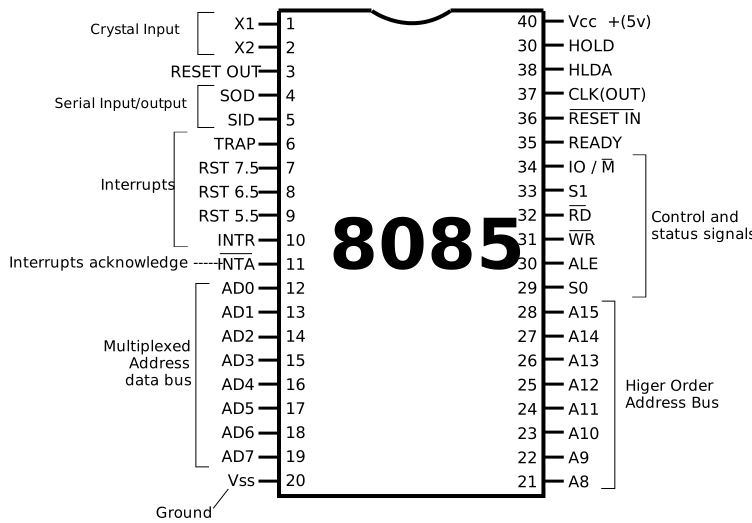
Assembly Language Programming
Assembly language programming for the 8085 microprocessor involves writing low-level code that directly controls the hardware. This type of programming is essential for understanding how microprocessors work, optimizing performance, and implementing critical real-time applications. The 8085 microprocessor, with its simple architecture and instruction set, is an excellent starting point for learning assembly language programming.